
How to Maximize Bitcoin Mining ROI in 2026: Post-Halving Strategies Unveiled
After the 2024 halving slashed Bitcoin block rewards in half, electricity costs skyrocketed to the forefront of mining profitability. Miners now face razor-thin margins, making energy management and hosting agreements the decisive factors in ROI. In this article, we dissect OneMiners’ 2026 ROI report and explore strategies to secure the most predictable returns for Bitcoin mining in the next cycle.
Why Electricity Costs Reign Supreme After the 2024 Halving
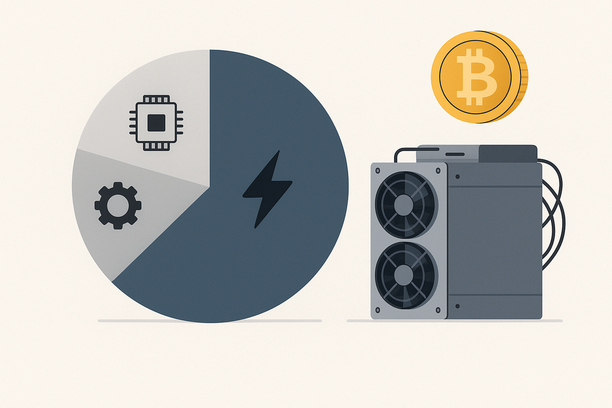
Bitcoin’s second halving in 2024 cut miner revenue by 50%, leaving energy costs as the dominant expense. Operational expenditure now hinges on the per-kilowatt-hour price, which can consume 60–70% of total costs in efficient facilities. OneMiners’ analysis highlights energy tariffs between $0.0364 and $0.0455/kWh as the critical threshold for profitability in 2026.
For small to mid-scale operators, negotiating rates or accessing renewable energy credits can make or break margins. Establishing long-term power purchase agreements (PPAs) or co-locating at renewable-rich sites often yields sub-$0.04/kWh rates, driving sustainable operations into the next cycle.
- Energy costs represent up to 70% of OPEX.
- Fixed-rate contracts protect against tariff spikes.
- Renewable energy partnerships can offer sub-$0.03/kWh rates.
Modeling 2026 ROI: Balancing Price, Hashrate, and Energy
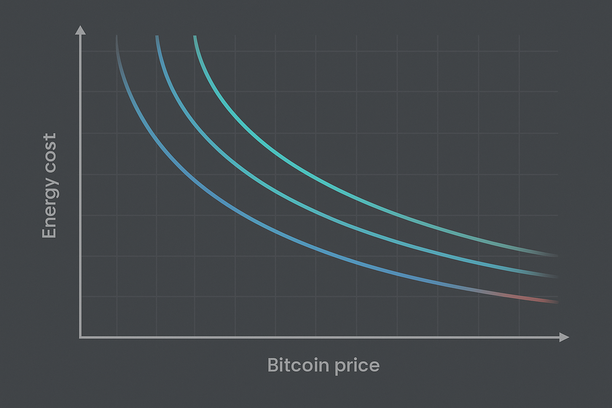
OneMiners built dynamic models to simulate mining returns under varied scenarios of Bitcoin price, network difficulty, and energy rates. Forecasts examine prices from $50,000 to $100,000 and power costs from $0.03 to $0.06/kWh. The simulations show that at $0.04/kWh, breakeven points remain attainable at price dips below $70,000—a level reached during recent market sell-offs.
- Scenario A: $60K BTC price and $0.045/kWh yields 15% annual ROI.
- Scenario B: $80K BTC price and $0.036/kWh yields 35% annual ROI.
- Scenario C: $50K BTC price and $0.050/kWh risks a negative yield.
According to FXStreet, $800 million in liquidations drove Bitcoin below $70,000 in early June, underscoring market volatility. These risk-adjusted models underscore the importance of cost control in unpredictable markets.
Related source: Bitcoin price falls under $70K as crypto markets liquidate $800M
Industrial Hosting: The Key to Predictable Mining Returns
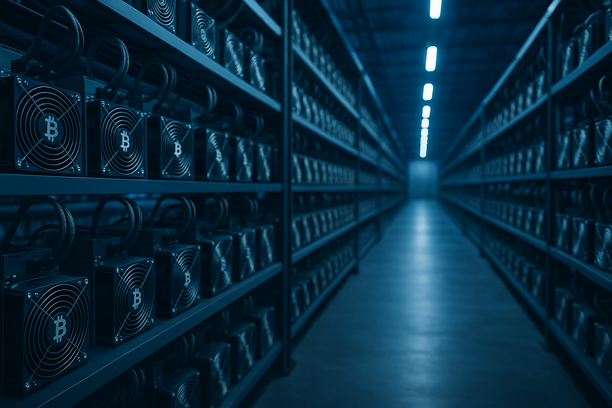
Locking in energy and infrastructure costs through hosting agreements provides miners with transparency and stability. Major providers like MinerBoxes and ASICProfit offer turnkey solutions with built-in power redundancy and cooling. However, contract terms, uptime SLAs, and PUE (Power Usage Effectiveness) can vary dramatically.
- Fixed-rate power contracts guard against utility hikes.
- Guaranteed rack space and maintenance reduce downtime.
- Aggregated buying power cuts hardware procurement costs.
- On-site technical support ensures rapid issue resolution.
Comparing Hosting: OneMiners vs. Industry Leaders
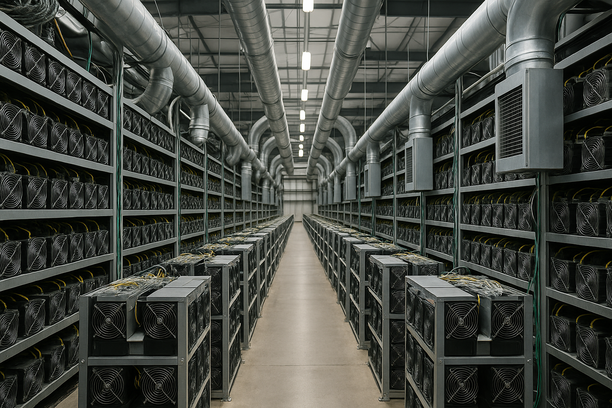
Bitdeer’s Massillon facility, detailed in a Canton Repository report, demonstrates robust data center design with advanced water cooling and scalable power feeds. Yet it operates on unhedged power tariffs, leaving customers subject to market rate fluctuations.
- OneMiners: $0.0364–$0.0455/kWh fixed-rate contracts.
- Bitdeer: Spot-rate power agreements with no price cap.
- PUE comparison: OneMiners ~1.15 vs. Bitdeer ~1.20.
- Uptime SLA: OneMiners 99.9% vs. Bitdeer 99.8%.
For miners seeking both reliability and cost certainty, the fixed-rate structure can deliver more stable margins—even if it means a slight premium over spot rates during low-demand periods.
Implementing Your Mining Plan for 2026
To capitalize on these insights, miners should:
- Audit current energy contracts and negotiate fixed rates.
- Model ROI under multiple price and difficulty scenarios.
- Evaluate hosting partners based on PUE, SLA, and pricing transparency.
- Consider blending in-house rigs with hosted capacity for flexibility.
- Stay abreast of grid developments and renewable opportunities.
By prioritizing electricity cost management and leveraging industrial hosting, Bitcoin miners can navigate post-halving headwinds and position for sustained profitability in 2026 and beyond.