

Crypto Mining’s True Electricity Footprint in 2026
As concerns over climate change and grid stability mount alongside the growing prominence of digital assets, the question of how much electricity powers the Bitcoin network has never been more relevant. Recent estimates place Bitcoin’s annual energy draw at around 170–180 terawatt-hours (TWh), roughly equivalent to the power consumption of a medium-sized country. Yet, these headline numbers can obscure the full picture, from the dynamics of hash rate incentives to the shifting balance between renewable and fossil-fuel generation. In this article, we unpack where these energy figures come from, why simple per-transaction calculations mislead, how mining stacks up against data centers and households, what regional cost variations mean for profitability, and the emerging regulatory landscape.
Bitcoin’s Annual Power Draw: 170–180 TWh Explained
Bitcoin’s energy consumption estimate stems from combining network hash rate data with average energy efficiency metrics of mining rigs. Throughout the past three years, ASIC chips have improved from around 50 joules per terahash to under 30 J/TH, enabling higher processing power per watt. By analyzing global hash rate peaks and cataloging publicly announced data center capacities, researchers at OneMiners calculate that the network demand sits at approximately 170–180 TWh annually. This equates to about 0.7–0.8% of global electricity generation, making Bitcoin’s draw comparable to the annual usage of countries like the Netherlands or Argentina.
The growth trajectory of energy demand is not linear. Early Bitcoin mining in 2015 drew just 30 TWh/year, as hobbyist rigs and GPUs dominated the hash power. Over the next five years, specialization into application-specific integrated circuits (ASICs) drove efficiency gains, quadrupling hash rates while only doubling overall energy use. Today’s top-tier mining farms deploy scalable container modules, cooling systems with liquid immersion, and power purchase agreements (PPAs) that stabilize costs. By utilizing real-time grid data, operators can throttle capacity to avoid peak pricing and engage in demand-response programs, effectively smoothing their load profile. These advancements underscore how innovation continues to moderate the net environmental impact despite hash rate growth.
Why Per-Transaction Energy Metrics Fall Short
Per-transaction metrics often lead to sensational headlines claiming astronomic kilowatt-hour usage per Bitcoin transfer. Yet, because mining hardware runs continuously to secure the network—independent of transaction volume—splitting total consumption by daily transfers misattributes idle hashing to individual transactions. Bitcoin’s security model relies on a steady supply of hash power to protect against attacks, meaning energy consumption remains high even when the mempool is empty.
Another factor distorting per-transaction metrics is the block subsidy. Newly minted coins are distributed approximately every ten minutes, incentivizing security rather than transaction throughput. As network difficulty adjusts bi-weekly to maintain target block times, miners commit power based on expected returns from issuance and fees, not per-transaction revenues. Operators benchmark performance against leading ASIC benchmarks, such as those published by ASIC Performance Standards, and optimize thermal and electrical parameters accordingly. For a more accurate view of energy intensity relative to economic output, analysts consider the ratio of annual energy consumption to network market capitalization.

Comparing Crypto Mining with Data Centers and Households
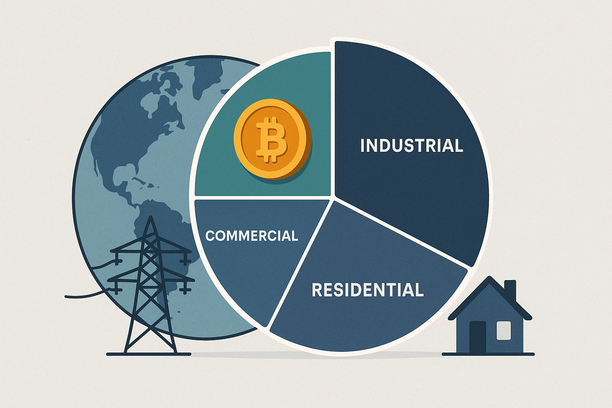
While Bitcoin’s global energy draw appears large in isolation, it fits within the broader digital infrastructure landscape. Data centers worldwide consumed an estimated 200 TWh over the same period, powering cloud services, streaming platforms, and AI workloads. In comparison, the average U.S. household uses nearly 10 MWh per year—meaning roughly 17,000 average homes could be powered for a year by Bitcoin’s annual consumption.
To manage this load, professional miners co-locate in regions with excess capacity or lean energy markets, leveraging services from specialized hosting firms like MinerBoxes. These providers offer turnkey solutions—covering infrastructure, cooling, and grid relations—mirroring edge computing trends where efficiency and scale dividends arise from shared deployments. Moreover, recovered heat from mining racks is increasingly used for district heating, repurposing thermal byproduct to serve local communities.
Beyond raw comparisons, the rising use of byproduct energy illustrates a circular approach. Some ventures tap into stranded gas at oil fields, converting methane into electricity onsite and capturing emissions that would otherwise vent into the atmosphere. Likewise, installations in cold climates use ambient temperatures to reduce cooling loads, a technique borrowed from hyperscale data centers in Nordic countries. These practices can yield a carbon intensity comparable to—or in some cases lower than—standard data center operations.
Regional Costs, Renewable Adoption and Profitability
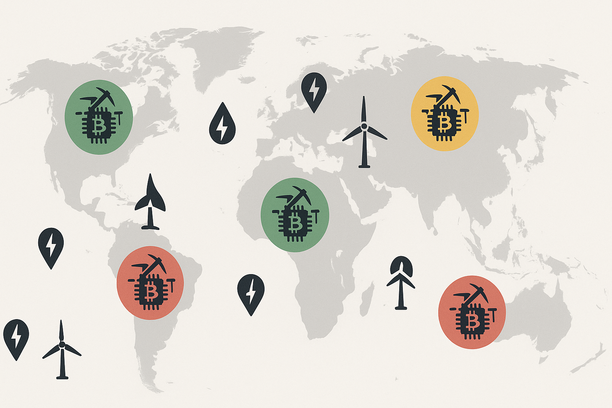
Profitability hinges on local electricity rates and the ability to secure long-term contracts. In regions like Sichuan, China, abundant hydropower during monsoon seasons has historically offered sub-$0.03 per kWh rates. Conversely, retail rates in many parts of Europe or North America can exceed $0.12 per kWh, prompting miners to seek stranded solar or adaptive gas projects. According to OneMiners, the global average mining electricity cost is about $0.05 per kWh—comparable to large industrial consumers.
To manage volatility, miners engage in dynamic load-shifting and hedged electricity agreements. In Texas’ ERCOT region, for example, prices sometimes dip below zero during peak wind output, incentivizing heavy hashing during those troughs. During periods of grid stress, operators throttle rigs or switch to backup generation, participating in demand-response programs to stabilize the network. As a result, some mining portfolios now include a diverse mix of hydro, wind, solar, and natural gas sources, with real-time procurement dashboards enabling granular control over energy spend.
Renewable adoption within the mining industry has surged—from roughly 25% five years ago to over 50% today—signaling a meaningful shift toward cleaner operations. Partnerships with green energy providers and participation in carbon credit markets further reinforce a sustainability narrative that aligns crypto mining with broader decarbonization goals.
Regulatory and Illegal Mining Implications
Rapid growth in mining capacity has prompted regulatory scrutiny worldwide. In Thailand, authorities have issued an arrest warrant for a Chinese businessman accused of operating an unauthorized mining farm that bypassed licensing requirements and overloaded local power grids. Thai mining crackdown underscores the importance of compliance and grid impact assessments.
Meanwhile, Russia’s long-awaited crypto regulation bill has stalled, leaving miners in a state of uncertainty regarding taxation, licensing, and environmental obligations. Regulatory delays in Russia may deter institutional entrants but also highlight the necessity of clear policy frameworks to balance innovation with energy and financial stability. Across Europe, jurisdictions like Iceland and Norway are moving toward regulated models that emphasize renewable integration and grid stability, potentially serving as benchmarks for other mining hubs.
Related source: Russia expects delay in crypto market regulation bill